
A screenplay desk beside a warmly lit film studio

TaleReed · AI INTERACTIVE STORY PLANNING WORKSPACE

Turn one idea into a shootable interactive story.

Describe a story premise. AI starts with the core conflict and helps shape your first planning draft.

Start with a character, goal, and obstacle0 / 1000
AI keeps the original idea and develops it through the seven-step framework

Enter to start · Shift + Enter for a new line

Meet TaleReed. Give your story a working shape.

TaleReed is a planning and writing workspace for stories the audience can change. Bring a premise to TaleReed, develop the decisions behind it, and leave with documents you can discuss before committing to a larger production.

A story plan you can review

TaleReed brings the premise, character motivations, player decisions, and production questions into one planning workspace. Instead of collecting disconnected chat replies, develop documents that explain what the audience does, why a choice matters, and what your next draft needs to resolve. TaleReed keeps the working text available for your own revisions.
Choices with consequences

TaleReed helps you discuss the cost behind a decision: a damaged relationship, a lost opportunity, a revealed secret, or a promise that becomes harder to keep. With TaleReed, describe both the immediate response and the later consequence. Your plan can then connect character intentions to the actions still available to the player.

Scope before the shoot

TaleReed gives production questions a place beside creative decisions. Identify the locations, actors, scenes, and alternate versions implied by your branches. Use TaleReed to outline a small prototype before expanding the full story. The workspace supports that planning conversation; your team still reviews feasibility, budgets, and the evidence gathered through playtesting.

A strong interactive story is not about having more choices.

Players should understand what they changed—and what it cost.

Seven documents from premise to validation.

Each step produces an editable Markdown document based on the Interactive Film Rapid Planning Kit.

  1. 01

    Project overview

    Start TaleReed with the experience you want to test, the intended audience, and the central conflict. The overview separates known constraints from creative assumptions so the project overview gives later decisions a clear reference.

  2. 02

    Characters and world

    Give TaleReed characters a desire, a pressure, and a reason to resist the protagonist. Describe the world rules that affect decisions, including what information each person has and what relationships they could lose.

  3. 03

    Story and chapter outline

    Shape the dramatic progression in TaleReed before filling every scene with dialogue. Discuss chapter goals, turning points, information reveals, and the moments when the player needs to make a consequential decision.

  4. 04

    Branching and interaction

    Map the choices in TaleReed as planning documents: what the player knows, which options appear, and where routes reconnect. Question branches that add writing and filming work without changing the experience.

  5. 05

    State variables and ending matrix

    Define the states your TaleReed story needs, such as trust, evidence, commitments, or access. Describe ending conditions and consequences in words that a writer, designer, and developer can review together.

  6. 06

    Node scripts

    Develop TaleReed node scripts around scene intentions, spoken dialogue, player input, and the response to each choice. Revise the wording yourself while discussing continuity and alternative approaches with the AI assistant.

  7. 07

    Production scope and validation

    Finish the TaleReed planning sequence with scope boundaries and a validation plan. Choose the smallest playable passage worth testing. Your documents should identify the unanswered questions to take into production review and player sessions.

The document leads. AI collaborates.

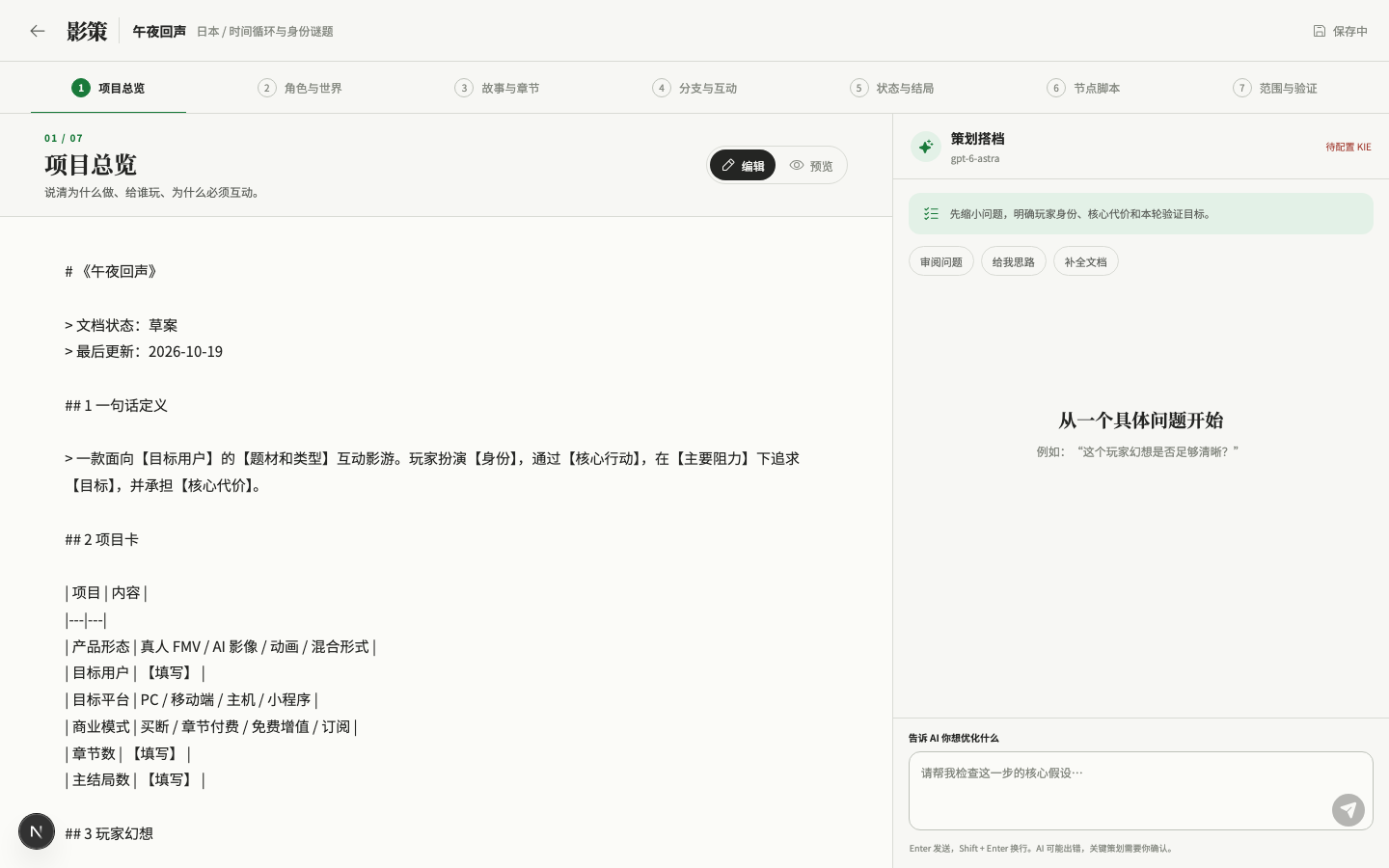
Edit Markdown on the left and work with AI on the right. AI can question, review, expand, and rewrite, but only your approval changes the document.

  • Streamed responses with visible progress
  • Saved to SQLite, never browser storage
  • Research, assumptions, and decisions stay distinct
Open workspace
TaleReed workspace with an editable planning document beside the AI conversation
Documents and conversation share one creative context.

One scene. A decision worth making.

Imagine a reunion where a friend asks you to hide evidence. In TaleReed, begin by asking why the protagonist might agree and what refusal would cost. Your draft can connect that decision to later access, trust, and the information another character is willing to reveal.

Compare versions before writing every branch. Can both routes return to the same location with different dialogue? Does either choice open a new action? TaleReed gives those questions a place in the plan, so the next scene responds to the player instead of simply commenting on the past.

Try your own premise in TaleReed
A fictional planning example

The envelope on the table

“If they see this, I lose everything. Will you keep it?”

Keep the evidencePreserve the friendship. Take responsibility for a secret that could surface later.
Refuse the requestLose immediate trust. Keep the option to approach another witness.

TaleReed review question: what can the player do next, and what new cost follows?

Different creative roles. A shared story to work on.

TaleReed fits the early work behind branching stories, from an independent first draft to a brief prepared for production review.

Independent FMV creators

Use TaleReed to turn a compact premise into a reviewable interactive film brief. TaleReed is useful when the same creator handles writing, interaction design, and early production planning. Keep the first version small enough to test, and use your documents to explain the intended experience when discussing a potential shoot.

Screenwriters exploring interaction

TaleReed gives a linear scene a second set of questions: what can the player change, what remains fixed, and what follows from refusal? Bring an existing premise into TaleReed, explore different pressures on the same relationship, and compare the dramatic purpose of alternative choices before drafting additional dialogue.

Narrative designers and producers

TaleReed provides a structured starting point for reviewing story logic and production scope. Export TaleReed documents to share through your existing review process. Use the same brief to discuss character arcs, state changes, and filming assumptions. The workspace supports the preparation; your chosen tools handle game implementation and production scheduling.

Do not begin from a blank page.

Explore 32 researched genre directions across five markets, with evidence boundaries and open questions intact.

Mainland China · 6 genres

realist mystery, identity reversal, historical espionage, folk horror, cultivation management, survival growth

Japan · 6 genres

honkaku mystery, ensemble viewpoints, time loops, psychological horror, youth romance, workplace procedural

United States · 6 genres

true crime, survival horror, AI ethics, apocalypse, period romance, meta-cinema

South Korea · 7 genres

relationship romance, revenge rebirth, social thriller, folk horror, survival games, historical identity, entertainment industry

Taiwan · 7 genres

folk horror, local crime, family issues, diverse relationships, investigation, historical memory, local comedy

Your first session with TaleReed.

Start with the part of the story you most want to understand. TaleReed helps you move from a useful question to a document you can review.

  1. 1

    Describe the conflict

    Open TaleReed with a short premise, an intended audience, and any constraints you already know. You can begin with a relationship under pressure; you do not need a complete plot, an ending list, or a polished pitch to start.

  2. 2

    Review one document at a time

    Discuss the current stage with TaleReed, read the proposed changes, and edit the document before confirming it. Your approval stays central to the process. Revisit earlier assumptions when a later choice exposes a problem in the story.

  3. 3

    Continue into the screenplay

    After confirming all seven stages, complete the TaleReed plan and continue into screenplay writing. Develop episodes and scenes from the agreed direction. Export your completed planning snapshot as Markdown for a readable copy to review outside the workspace.

Room for your next draft.

Try TaleReed with 2,000 introductory credits. Choose a paid plan when you need more projects or a larger AI allowance. All plans include the core planning workflow, screenplay editing, and Markdown export.

TaleReed Basic

$10USD / month

10,000 credits per monthly period
Up to 10 projects

Or $96 USD per year.
Annual billing saves 20%.

View Basic details

TaleReed Plus

$20USD / month

24,000 credits per monthly period
Up to 50 projects

Or $192 USD per year.
Annual billing saves 20%.

View Plus details

TaleReed Pro

$100USD / month

150,000 credits per monthly period
Up to 200 projects

Or $960 USD per year.
Annual billing saves 20%.

View Pro details

TaleReed paid plans currently require administrator activation after payment verification. Submitting a request does not charge you. Annual credits are granted together, and remaining credits are retained. Review the full pricing page for limits, credit calculations, and activation terms.

Before you begin.

Practical answers about TaleReed, from the first draft to the next planning session.

Full TaleReed pricing FAQ
What is TaleReed?

TaleReed is an AI assisted planning and writing workspace for interactive films, live action drama, and full motion video games. It organizes development into seven editable planning documents, then supports screenplay work. The aim is to make your story decisions clear enough to review, revise, and test before production.

How does TaleReed differ from a general AI chat?

TaleReed places the working document alongside the conversation and organizes discussion around a specific planning stage. The assistant can help question assumptions, suggest alternatives, and review a draft. You decide what becomes part of the document. That structure gives each conversation a concrete writing or design task.

Can I try TaleReed before choosing a paid plan?

Yes. TaleReed gives a new account 2,000 introductory credits and supports up to three projects on the Free plan. These introductory credits are granted once, rather than every month. The Free plan includes the seven stage planning workflow, manual editing, screenplay editing, and Markdown export across plans.

How does TaleReed calculate AI credits?

TaleReed charges for the tokens used by an AI request: 20 credits per thousand uncached input tokens, two per thousand cached input tokens, and 100 per thousand output tokens. The combined request total is rounded upward. Inputs can include your question, system instructions, selected documents, and conversation history. Manual editing and export do not spend credits.

Will TaleReed generate a finished video game?

TaleReed produces planning and writing material, rather than a playable game or a finished film. Work through scenes, choices, states, and production questions. Your project still needs human review, implementation, filming or asset creation, and player testing with the tools and people you choose.

Can I keep editing my TaleReed drafts myself?

Yes. TaleReed supports direct document editing as well as AI assisted discussion. Your project belongs in your personal bookshelf, where you can return to the work. Markdown export gives you a portable text version of your completed planning snapshot for external review, archiving, or continued writing in another editor.

How are TaleReed paid plans activated?

TaleReed currently uses administrator assisted activation. Choose a plan and submit a request, then arrange payment with the site administrator. The request itself does not charge you or immediately activate paid limits. The administrator grants the plan and its credits after the administrator verifies the payment; automatic card checkout is not connected yet.

What happens when a TaleReed plan expires?

Your TaleReed documents remain available to view, edit, and export. Remaining credits are retained, while effective project and generation limits return to the Free tier after the paid period ends. Annual plans cost 20 percent less than twelve monthly periods and grant the annual credit allowance together when activated.

Keep a useful reference nearby.

Explore TaleReed resources alongside your project. Use the game directory to find reference points, the tools directory to understand planning roles, and the blog to read about story development. TaleReed research can inform a discussion; your audience, budget, and playtests determine which ideas fit your own production.

Start with the conflict you most need to test.

Create project